

Not a Rant
a poem for Palestine and a book recommendation

Last Sunday morning I joined an online, two-hour workshop on writing political poetry. It was led by Steve Pottinger, a friend from pre-Covid days, when we hosted face-to-face poetry events and travelled to take part in festivals and book-launches in the north, east and west of Britain. Steve came down from his home in the Midlands to be our featured poet at least twice, and we’ve followed his poetry, his videos and his festival appearances for at least twelve years, with enormous respect and pleasure.
I remember when the term ‘political poem’ was synonymous with ‘rant’ — in fact proponents of the genre were proud to call themselves' ‘ranters’. Times have changed. As Steve said in his workshop, no-one likes to be shouted at, and what is the point of a political poem if it turns listeners off? I have attempted very few poems on political topics, as a result of that early experience (OK, I was in my 60s at the time, but it was early in my experience of writing poetry).
In Steve’s workshop, I explored my own political concerns in the company of other writers and found I could name some themes that I wanted to write about. I also had to consider how much of a complex issue I could actually confront in one poem, and who I was writing such a poem for. And, of course, then came the question of how to engage that audience.
To cut a long story short, I did manage to draft a poem in the workshop, beginning with a couple of tercets (not haiku except for their syllable count) and elaborating on those to arrive at this:
Final Solution
(for dispossessed West Bank Palestinians)

When they came with hoses
to spray our walls with shit
we held our noses
and dealt with it.

When they burned our olive trees
that saw the birth and death
of our great-grandfathers
we planted saplings and drew breath.

When they came with sticks and guns
we challenged them. Mourning we buried our sons,
watched our farmland day and night,
asked foreign witnesses to assert our rights.

But when they came with legal documents
newly drawn up by their home government,
soldiers and bulldozers, we knew they'd won.

Steve's workshop was excellent and well-structured. I understand that he will be offering it again at a summer school this year. He offered it free this month, just suggesting a contribution to the Freedom from Torture charity.
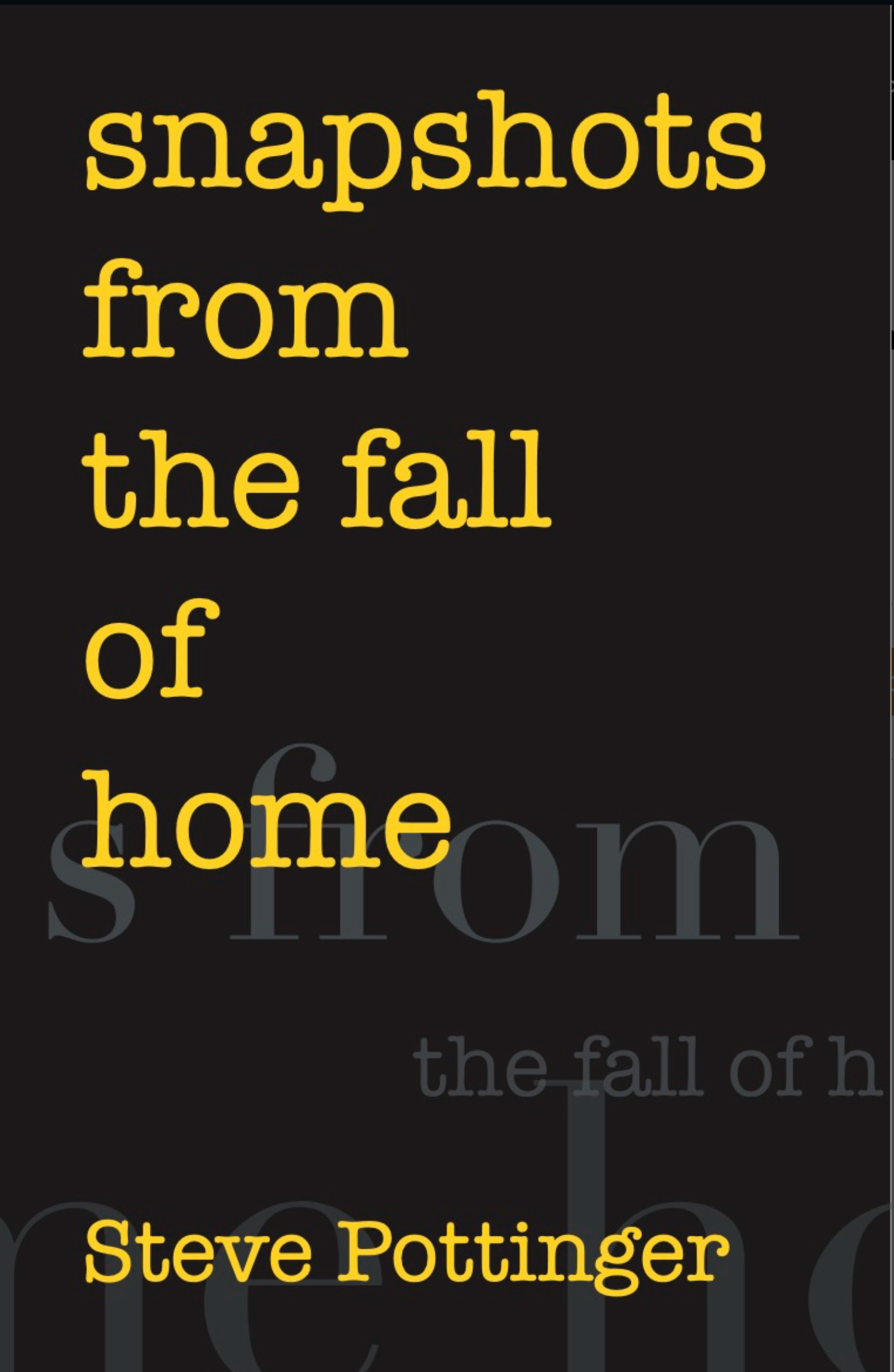
This is Steve Pottinger's latest book: 'Snapshots from the fall of home'.

The poems in this collection celebrate and commiserate with the inhabitants of the cities of twenty-first century Britain, in the voices of the young, the old, the homeless, the commuters on the motorways, the sick and the exhuberantly alive.

On the back of his book Steve writes:
'At the heart of [my] seventh book of poems — and this will come as no surprise if you know [my] poems — are people. People in all their wondrous, ragged, bumbling glory. People getting by, and others who aren't. People who dream of better days, and those who fear things are going to get worse. People stuck in traffic. People who want change, and people who are simply seizing the moment. Glorious, every one of them...'

I've read this book at a sitting, entranced by the light that Steve sheds on these lives, even those of quiet desperation.

The thread of rebellion runs through the poems, borne on a wave of clear-sighted understanding, sarcasm, kindness and dry humour. In a parody of William Carlos Williams' well-known confession, an oil executive owns up: 'I have eaten / the future [...] it was delicious / so profitable / and so cold'.

In 'heal me quickly—there's fighting to be done' NHS patients ferment rebellion against the underfunding and understaffing of the NHS, and exhort:

'Let us rise, all of us, from our sickbeds
spring from the back of ambulances
paramedics trailing behind us
[...}
let us wheel ourselves, carrying
each other's drips, limping on crutches,
testing out our artificial hips
[...} as we march through traffic,
along pavements, down streets, over bridges,
[...}
battered, scarred, broken, frail,
beautiful and enduring,
let us rise'

And in 'Fatima', inspired by a government ad urging a ballerina to retrain as an IT worker, we have a wonderful picture of the retrained dancer hacking the accounts of the politicians who put forward this insulting suggestion, and ruining their lives in revenge!

Steve Pottinger's lyrical imagination makes stories in which ordinary people cope. A homeless man's life 're-ravells' as time runs in reverse; a superhero performs small healing miracles with kindly casual human contacts; a housewife switches off the threatening newscasts and dances ecstatically in her orange kitchen; a house becomes a home, restored from ruin and filled with friends and music.

This is a book to come back to and enjoy over and over again. I highly recommend it, and also the previous six books by Steve, all on the publisher's site. You can see Steve reading his poems on his You Tube site, too. His substack profile is https://substack.com/@stevepottinger

'Snapshots from the fall of home' is available from Steve Pottinger's website and from the publisher ignitebooks.co.uk. It costs £10 including postage.
The power of poetry and politics- your poem and also thank you for the recommendation to Steve and his work
Well done, Janice!